This article is Episode 2 of the Satya–Chandra series Why Matter Exists.
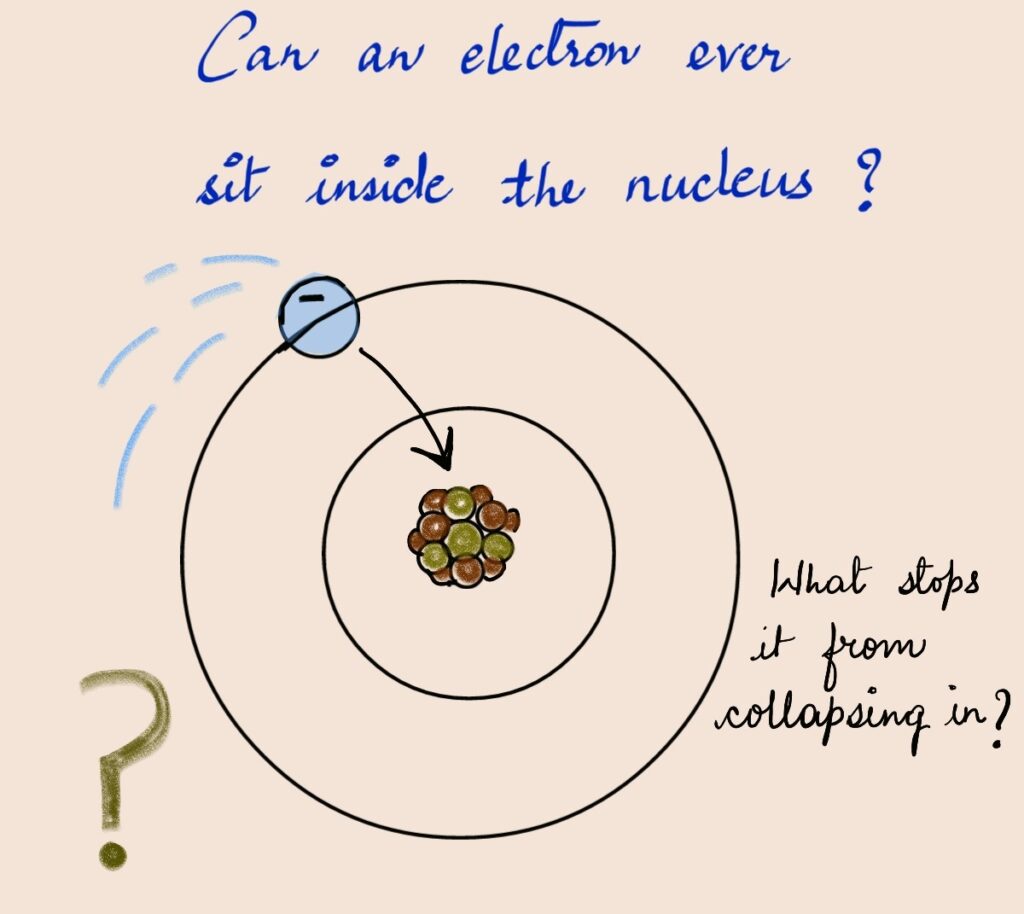
 I’ve been thinking about our last conversation.
You said the electron doesn’t collapse because the lowest allowed state is 
But that doesn’t satisfy me.
 Why not?
Because it feels like a mathematical trick.
We simply wrote

And declared 
Then we concluded the electron cannot reach the nucleus.
Nature doesn’t work because of our equations.
Our equations are supposed to describe nature.
Why does nature forbid it?
This is where modern quantum mechanics gives us a deeper answer.
The electron is not merely a tiny particle. It also behaves like a quantum wave.
According to Heisenberg’s uncertainty principle:

Here,  and
and  represent the uncertainties in the electron’s position and momentum, respectively.
Now imagine if we confine an electron to a region as tiny as a nucleus, about  across. That means, according to Heisenberg’s principle, such a tiny uncertainty in position demands an enormous uncertainty in its momentum and therefore an enormous kinetic energy.
Satya:
Enormous??? Can we actually calculate how impossible it is for the electron to stay inside the nucleus?
Chandra:
Certainly,
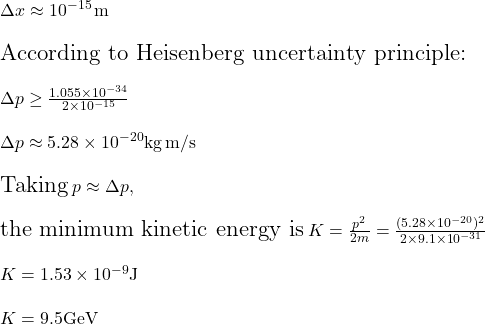
Whoo… that’s too high.
Yes,
to squeeze an electron into the nucleus, nature demands an enormous kinetic energy.
Ah! So the electron doesn’t stay outside because the proton stops attracting it…it stays outside because squeezing it into the nucleus would require an enormous amount of energy!
But one mystery still remains…
If the electron cannot fall into the nucleus, why does it settle at one particular distance?
The answer lies in one of the most remarkable numbers in physics—the Bohr radius.
Episode 3: Why is the Bohr Radius About 0.53 Å ?
Leave a Reply